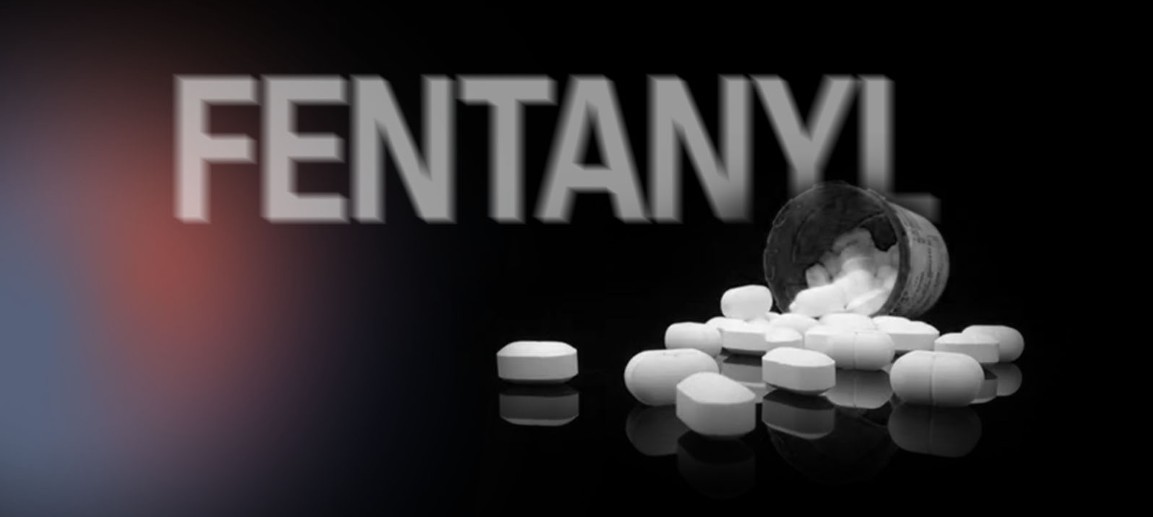

Fentanyl is a powerful synthetic opioid, originally developed for pain management under medical supervision. But the fentanyl causing today’s public-health crisis is often illicit, manufactured in underground labs, mixed into other drugs, or pressed into pills or powders — oftentimes without consumer knowledge — before being sold on the black market. Estimated to be 50 to 100 times stronger than morphine at certain doses, even very small amounts can be lethal.
In recent years, fentanyl has been the primary driver behind the surge in overdose deaths in the United States. According to recent provisional data from the CDC, synthetic opioids — mostly fentanyl — accounted for roughly 69% of all overdose deaths.
Fentanyl is extremely dangerous for several reasons. Because of its high potency, the difference between a “dose” and a lethal dose can be tiny. Some experts estimate that just a few milligrams can kill. Because it’s so strong and compact, fentanyl is easy to transport and distribute, whether as powder, pill, or mixed into other drugs. That makes it harder to trace and easier for it to spread widely.
Illicit fentanyl products are rarely pure. They’re often mixed with other drugs, fillers, or even deadly contaminants that a user may not know they’re ingesting. This unpredictability dramatically increases overdose risk. Fentanyl also acts within minutes. If a person’s breathing slows or stops, there may be little time to respond before irreversible harm occurs.
Recognizing the deadly rise in fentanyl-related overdoses, U.S. Congress passed the HALT Fentanyl Act in 2025, and it became law on July 16 of that year. The law permanently classifies all fentanyl-related substances (FRS) — including analogues and chemically similar variants — as Schedule I drugs under the Controlled Substances Act. Schedule I is the most restrictive classification, defined as substances with a high potential for abuse and no accepted medical use.
It also closes a long-exploited “analogue loophole,” where traffickers slightly altered fentanyl’s chemical structure to skirt existing laws. Now, any substance with the chemical profile of fentanyl qualifies under the prohibition.
The HALT Fentanyl Act — while not a magic bullet — represents a significant step forward on the policy side. It aims to dismantle the chemical arms race where traffickers tweak fentanyl’s structure to evade laws. Penalties for trafficking or possessing fentanyl-related substances remain severe, especially for larger quantities, giving law enforcement clearer and more permanent legal tools.
But legal enforcement must go hand-in-hand with prevention, treatment, and community outreach. Focus needs to be put on increased access to treatment and recovery resources. Public education, especially among youth and vulnerable populations, is vital.
The latest national data offers a mixed picture. On one hand, provisional statistics show a substantial drop in overdose deaths: a nearly 24% decline in total overdose deaths for the 12 months ending September 2024 compared to the prior year.
That’s progress, and it suggests that harm reduction efforts, expanded access to treatment, and policies like HALT are making a difference. But even as deaths drop, overdoses remain the leading cause of death for Americans aged 18–44, highlighting the urgency of continued action.
Moreover, the supply of fentanyl and its analogues — including new variants — continues to evolve. Experts warn that the drug trade adapts quickly, and new versions of fentanyl might still emerge. Given the risks, it should be assumed that no substance is safe. Even something that looks benign could be laced with fentanyl.
Fentanyl is among the most dangerous substances to hit the U.S. drug supply — but it doesn’t have to be hopeless. The recent HALT law gives communities and law enforcement stronger tools to fight trafficking. Meanwhile, harm reduction, treatment, and public education are saving lives every day.
Being informed and cautious is the best way to protect yourself and your loved ones. If you or someone you know is struggling with opioid use or addiction, help is out there and recovery is possible. Hickory House Recovery is available 24/7 at 800-604-2117. Speak with our professional staff and let them help you take the next step toward safety and recovery.